A Deep Dive into the History of Art and Design
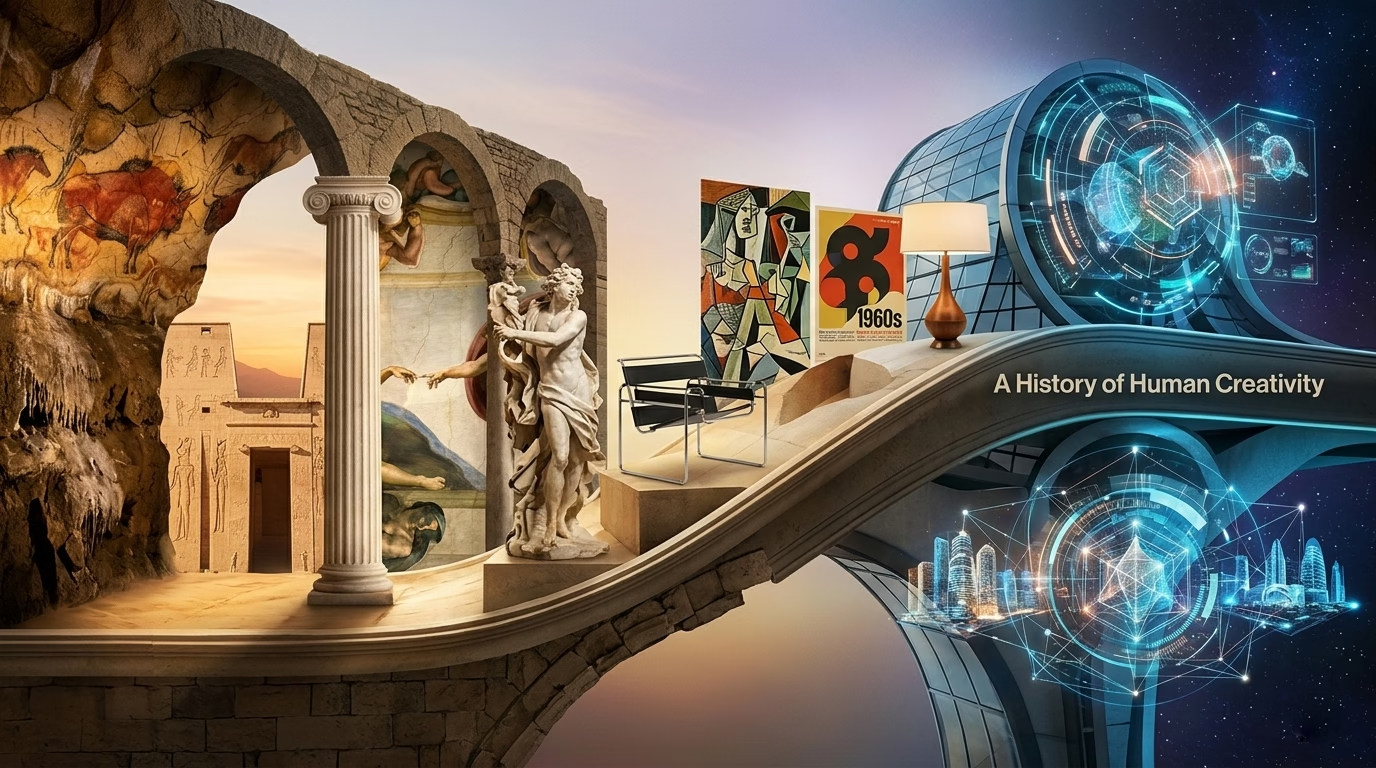
Art and design, while distinct in their primary functions (art often prioritizing expression and interpretation, and design prioritizing problem-solving and utility), are deeply intertwined. Both are fundamental threads in the rich tapestry of human history, reflecting our evolving beliefs, technologies, and social structures. Their stories are not linear progressions, but a complex narrative of innovation, reaction, and constant reinvention. This exploration will guide you through the significant epochs of this shared history, illuminating how visual expression has shaped and been shaped by the human experience. I. The Dawn of Expression: Prehistoric and Ancient Foundations The history of art begins long before written records. Prehistoric art, emerging in the Paleolithic era, provides our first glimpse into the nascent human mind. Paleolithic Cave Paintings: The First Gallery The oldest known visual expressions are found deep within caves. The Cave of Altamira in Spain and Lascaux in France, dating back over 15,000 years, contain stunningly preserved paintings of animals like bison, horses, and deer. These are not mere decorations; they are sophisticated compositions utilizing natural contours of the rock and ground pigments. Their purpose remains debated. Some scholars argue they were part of hunting magic or shamanistic rituals, intended to exert control over the animal world. Others see them as narrative spaces, the earliest attempts at storytelling and documenting tribal history. Regardless, they demonstrate an inherent human drive to create, to represent the world, and to imbue spaces with meaning. The sheer skill and observation required to depict these animals in motion, with depth and texture, is a testament to the sophisticated visual language that predates agriculture and permanent settlements. Ancient Egypt: Art for Eternity As complex societies emerged in the fertile river valleys of Egypt and Mesopotamia, art and design became tools of power, religion, and propaganda. Ancient Egyptian art, spanning thousands of years, is defined by its remarkable consistency and its dedication to the afterlife. Egyptian ‘design’ was highly codified. Architecture, sculpture, and painting all followed strict canonical rules. In painting, the “composite view” (where the head, hips, and legs are in profile, while the eye and shoulders face front) was mandatory for figures of high status. This style prioritizes clarity and conceptual wholeness over realistic distortion from a single viewpoint. The scale of figures indicated social hierarchy; pharaohs were depicted as giants next to their subjects. Their massive monuments, like the Pyramids of Giza, were ultimate feats of engineering and design, built to ensure the pharaoh’s immortality and the stability of Ma’at (cosmic order). Classical Antiquity: The Human Scale The ancient Greeks shifted the focus from the eternal to the human. Influenced by Egypt, Greek art initially followed stiff, formulaic patterns (the Archaic Kouros figures). However, the Classical period (5th-4th century BCE) witnessed a revolution: a drive toward naturalism and the pursuit of ideal beauty based on human proportion. Sculptors like Polykleitos developed mathematical systems (the Canon) for the perfect human form. They mastered contrapposto—the natural, asymmetric balance of the body when weight is shifted to one leg—creating statues that seemed to breathe and move. Greek architecture, exemplified by the Parthenon in Athens, achieved harmony and balance through precise geometric ratios and subtle optical corrections (such as the slight swelling of columns, or entasis). This idealized, humanist approach—focusing on harmony, balance, and rational order—laid the foundation for two millennia of Western art and design. II. The Renaissance: The Rebirth of Humanism Following the decline of Rome and the symbolic dominance of the medieval Church (where art was primarily a didactic tool for Bible stories), the 14th century saw a dramatic rebirth (Rinascita) in Italy. The Renaissance was a cultural flowering driven by renewed interest in classical antiquity, scientific observation, and human potential. The Golden Age of Florence and Rome This era fundamentally changed the definition of the artist from a skilled craftsman to an intellectual genius. Key innovations defined this transformation: While Florence was the early cradle (celebrating artists like Donatello and Botticelli), the High Renaissance (c. 1495–1520) shifted to Rome, fueled by papal patronage. The Sistine Chapel ceiling (Image 1) by Michelangelo epitomizes the High Renaissance ambition. This monumental fresco cycle fuses classical, dynamic, muscular figures with a profound theological narrative. Michelangelo’s figures, like the iconic image of God bestowing life upon Adam, are imbued with an intense spiritual energy (terribilità). The entire design demonstrates a complex intellectual program and an unparalleled mastery of the human form in motion, applied to a vast, challenging architectural space. Simultaneously, Raphael’s School of Athens in the Vatican apartments visualized the ideal of harmonious human reason, bringing together history’s great thinkers in a perfectly balanced perspective environment. III. Reaction and Revolution: Baroque to Romanticism The harmony and idealization of the High Renaissance did not last. The 16th and 17th centuries, marked by religious fracture (the Reformation and Counter-Reformation) and the rise of absolute monarchies, demanded a new, more emotive visual language. The Baroque: Drama, Emotion, and Grandeur Baroque art and design sought to overwhelm the senses. Where Renaissance art was static and harmonious, Baroque art was dynamic, theatrical, and full of energy. Caravaggio pioneered tenebrism, an extreme form of chiaroscuro, using harsh, theatrical spotlights to create intense drama and emotional immediacy. In architecture and design, the Baroque style used curves, complex shapes, and rich materials to create spectacles of power. The Palace of Versailles in France, the ultimate expression of absolutism, unified architecture, interior design, landscape, and sculpture into a single, cohesive statement of Louis XIV’s power. Sculpture, exemplified by Gian Lorenzo Bernini, sought to freeze the most dramatic, climactic moments of a narrative (like David mid-swing), using spiraling compositions and realistic textures that transcended the limitations of marble. The 18th Century: Rococo and Neoclassicism Following the death of Louis XIV, the heavy, formal Baroque softened into the Rococo, a style defined by light colors, asymmetrical curves, and playful, often frivolous, aristocratic subjects. Rococo was an interior design-driven style, focusing on the intimate salon rather than the monumental palace. This lightness triggered a fierce reaction: Neoclassicism. Fueled by the Enlightenment’s logic and