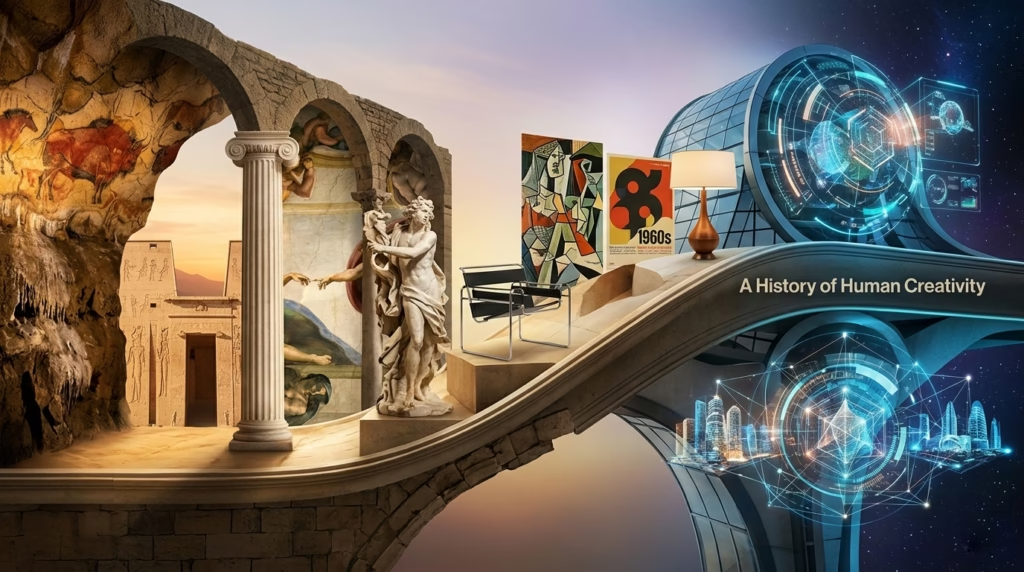
Art and design, while distinct in their primary functions (art often prioritizing expression and interpretation, and design prioritizing problem-solving and utility), are deeply intertwined. Both are fundamental threads in the rich tapestry of human history, reflecting our evolving beliefs, technologies, and social structures. Their stories are not linear progressions, but a complex narrative of innovation, reaction, and constant reinvention.
This exploration will guide you through the significant epochs of this shared history, illuminating how visual expression has shaped and been shaped by the human experience.
I. The Dawn of Expression: Prehistoric and Ancient Foundations
The history of art begins long before written records. Prehistoric art, emerging in the Paleolithic era, provides our first glimpse into the nascent human mind.
Paleolithic Cave Paintings: The First Gallery
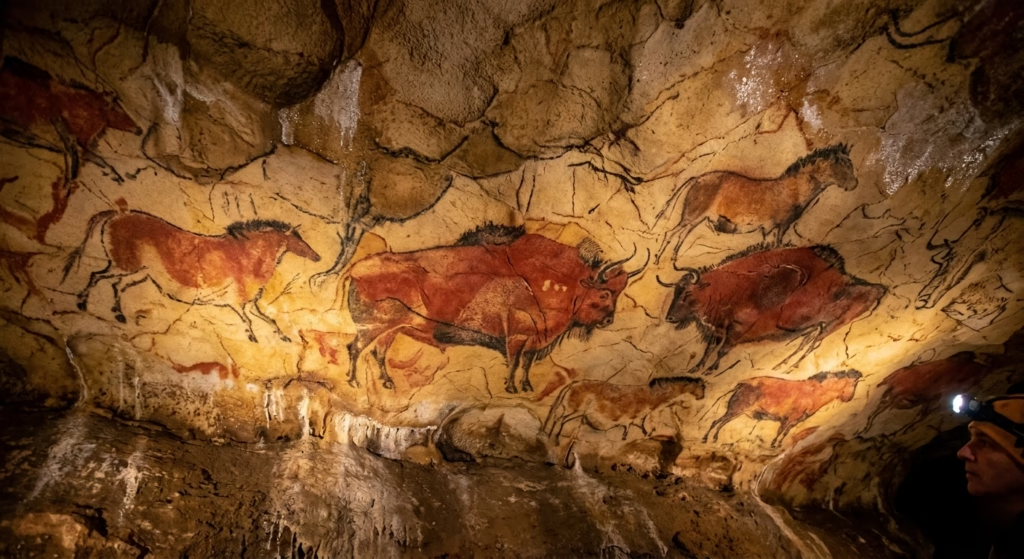
The oldest known visual expressions are found deep within caves. The Cave of Altamira in Spain and Lascaux in France, dating back over 15,000 years, contain stunningly preserved paintings of animals like bison, horses, and deer. These are not mere decorations; they are sophisticated compositions utilizing natural contours of the rock and ground pigments.
Their purpose remains debated. Some scholars argue they were part of hunting magic or shamanistic rituals, intended to exert control over the animal world. Others see them as narrative spaces, the earliest attempts at storytelling and documenting tribal history. Regardless, they demonstrate an inherent human drive to create, to represent the world, and to imbue spaces with meaning. The sheer skill and observation required to depict these animals in motion, with depth and texture, is a testament to the sophisticated visual language that predates agriculture and permanent settlements.
Ancient Egypt: Art for Eternity
As complex societies emerged in the fertile river valleys of Egypt and Mesopotamia, art and design became tools of power, religion, and propaganda. Ancient Egyptian art, spanning thousands of years, is defined by its remarkable consistency and its dedication to the afterlife.
Egyptian ‘design’ was highly codified. Architecture, sculpture, and painting all followed strict canonical rules. In painting, the “composite view” (where the head, hips, and legs are in profile, while the eye and shoulders face front) was mandatory for figures of high status. This style prioritizes clarity and conceptual wholeness over realistic distortion from a single viewpoint. The scale of figures indicated social hierarchy; pharaohs were depicted as giants next to their subjects. Their massive monuments, like the Pyramids of Giza, were ultimate feats of engineering and design, built to ensure the pharaoh’s immortality and the stability of Ma’at (cosmic order).
Classical Antiquity: The Human Scale
The ancient Greeks shifted the focus from the eternal to the human. Influenced by Egypt, Greek art initially followed stiff, formulaic patterns (the Archaic Kouros figures). However, the Classical period (5th-4th century BCE) witnessed a revolution: a drive toward naturalism and the pursuit of ideal beauty based on human proportion.
Sculptors like Polykleitos developed mathematical systems (the Canon) for the perfect human form. They mastered contrapposto—the natural, asymmetric balance of the body when weight is shifted to one leg—creating statues that seemed to breathe and move. Greek architecture, exemplified by the Parthenon in Athens, achieved harmony and balance through precise geometric ratios and subtle optical corrections (such as the slight swelling of columns, or entasis). This idealized, humanist approach—focusing on harmony, balance, and rational order—laid the foundation for two millennia of Western art and design.
II. The Renaissance: The Rebirth of Humanism
Following the decline of Rome and the symbolic dominance of the medieval Church (where art was primarily a didactic tool for Bible stories), the 14th century saw a dramatic rebirth (Rinascita) in Italy. The Renaissance was a cultural flowering driven by renewed interest in classical antiquity, scientific observation, and human potential.
The Golden Age of Florence and Rome
This era fundamentally changed the definition of the artist from a skilled craftsman to an intellectual genius. Key innovations defined this transformation:
- Linear Perspective: Credited to the architect Filippo Brunelleschi and codified by Leon Battista Alberti, this system used mathematical principles to create a convincing illusion of three-dimensional depth on a two-dimensional surface. This transformed painting from a symbolic backdrop to a window onto a coherent, measurable world.
- Chiaroscuro: Mastering the subtle gradation of light and shadow allowed painters to model forms with unprecedented volume and realism.
- Anatomical Accuracy: Renaissance artists like Leonardo da Vinci dissected bodies to understand musculature and movement, infusing their figures with profound life.
While Florence was the early cradle (celebrating artists like Donatello and Botticelli), the High Renaissance (c. 1495–1520) shifted to Rome, fueled by papal patronage.
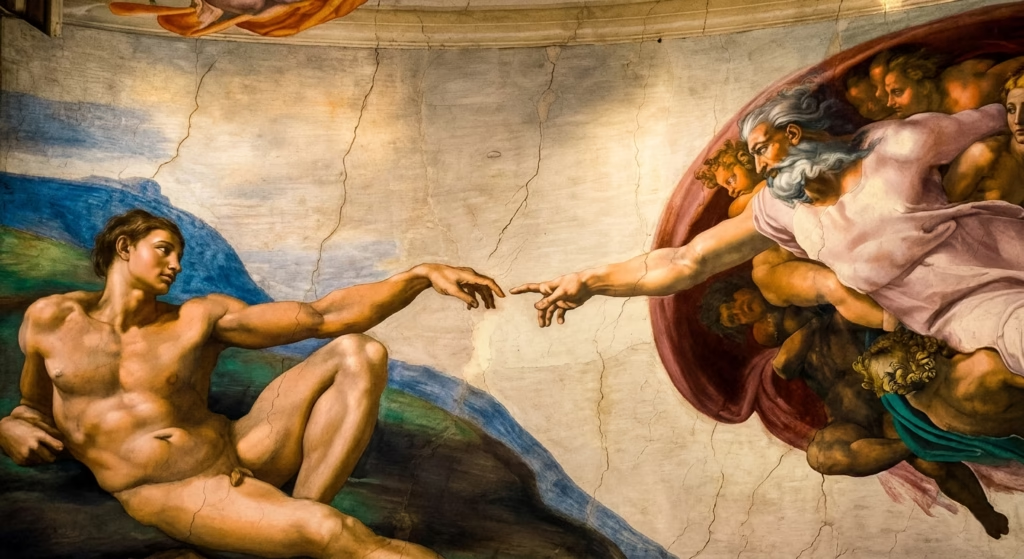
The Sistine Chapel ceiling (Image 1) by Michelangelo epitomizes the High Renaissance ambition. This monumental fresco cycle fuses classical, dynamic, muscular figures with a profound theological narrative. Michelangelo’s figures, like the iconic image of God bestowing life upon Adam, are imbued with an intense spiritual energy (terribilità). The entire design demonstrates a complex intellectual program and an unparalleled mastery of the human form in motion, applied to a vast, challenging architectural space. Simultaneously, Raphael’s School of Athens in the Vatican apartments visualized the ideal of harmonious human reason, bringing together history’s great thinkers in a perfectly balanced perspective environment.
III. Reaction and Revolution: Baroque to Romanticism
The harmony and idealization of the High Renaissance did not last. The 16th and 17th centuries, marked by religious fracture (the Reformation and Counter-Reformation) and the rise of absolute monarchies, demanded a new, more emotive visual language.
The Baroque: Drama, Emotion, and Grandeur
Baroque art and design sought to overwhelm the senses. Where Renaissance art was static and harmonious, Baroque art was dynamic, theatrical, and full of energy. Caravaggio pioneered tenebrism, an extreme form of chiaroscuro, using harsh, theatrical spotlights to create intense drama and emotional immediacy.
In architecture and design, the Baroque style used curves, complex shapes, and rich materials to create spectacles of power. The Palace of Versailles in France, the ultimate expression of absolutism, unified architecture, interior design, landscape, and sculpture into a single, cohesive statement of Louis XIV’s power. Sculpture, exemplified by Gian Lorenzo Bernini, sought to freeze the most dramatic, climactic moments of a narrative (like David mid-swing), using spiraling compositions and realistic textures that transcended the limitations of marble.
The 18th Century: Rococo and Neoclassicism
Following the death of Louis XIV, the heavy, formal Baroque softened into the Rococo, a style defined by light colors, asymmetrical curves, and playful, often frivolous, aristocratic subjects. Rococo was an interior design-driven style, focusing on the intimate salon rather than the monumental palace.
This lightness triggered a fierce reaction: Neoclassicism. Fueled by the Enlightenment’s logic and the exciting archaeological discoveries at Pompeii, Neoclassicism sought a return to the moral virtue, order, and ‘noble simplicity’ of ancient Greece and Rome. This was the visual language of revolutions. In France, Jacques-Louis David’s austere, patriotic paintings (like The Oath of the Horatii) served as propaganda for the French Revolution, contrasting starkly with Rococo self-indulgence. In design and architecture, Thomas Jefferson adopted Neoclassicism for the emerging American republic, believing its rational order embodied democratic ideals.
IV. The Modern Fracture: Impressionism to the Avant-Garde
The 19th century was defined by upheaval—the Industrial Revolution, urbanization, and new political ideologies. Art, in turn, began to fracture, with artists progressively challenging the authority of the Academy and the definition of ‘art’ itself.
The Birth of Modernism: Impressionism and Post-Impressionism
Modernism began with a radical shift: challenging the very purpose of painting. The Impressionists, emerging in 1870s Paris, were the first true “moderns.” Rejecting the historical, mythological subjects favored by the Salon, they focused on the painting itself as a sensory experience. They sought to capture the fleeting impression of light and atmosphere on a landscape or a modern scene. Utilizing new, portable synthetic pigments, they painted en plein air (outdoors), with loose, visible brushstrokes and pure, unblended color. Claude Monet’s series of paintings (of haystacks or the Rouen Cathedral) were not studies of the object, but studies of how light dissolves and transforms the object.
Following Impressionism, Post-Impressionists utilized its formal language but sought deeper meaning. Paul Cézanne strove to “make of Impressionism something solid and durable,” focusing on underlying geometric structure and paving the way for Cubism. Vincent van Gogh utilized swirling brushwork and expressive, non-naturalistic color to convey raw emotion, prefiguring Expressionism.
The 20th Century: Radical Abstraction
The dawn of the 20th century unleashed a torrent of “Isms,” each a more radical break from tradition than the last.
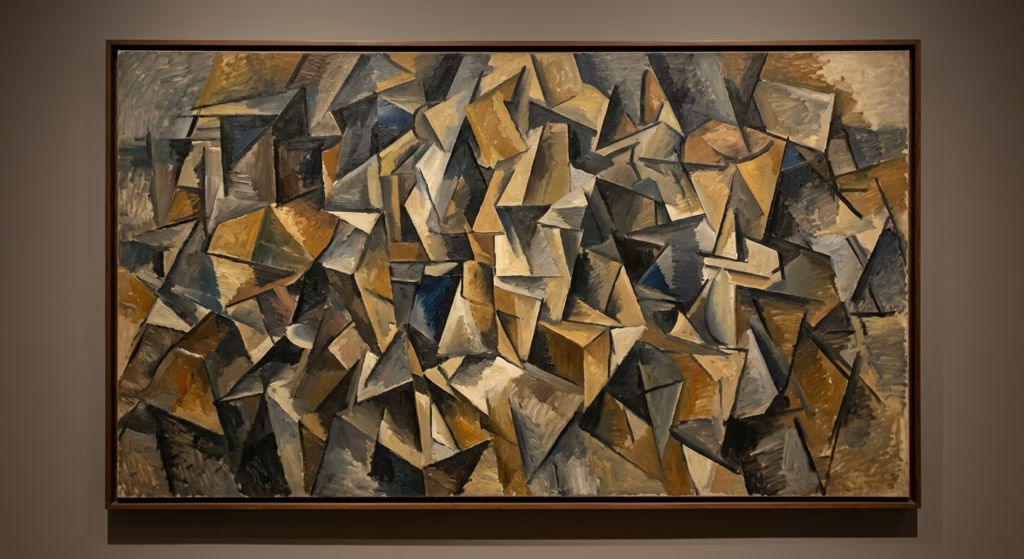
- Cubism: Developed by Pablo Picasso and Georges Braque, Cubism radically deconstructed objects, analyzing and reassembling them from multiple viewpoints simultaneously. It rejected the 500-year authority of linear perspective, acknowledging the flat canvas as the primary reality.
- Abstraction: Artists like Wassily Kandinsky and Piet Mondrian argued that art didn’t need a recognizable subject at all. Kandinsky believed color and form alone could evoke spiritual and emotional resonance, while Mondrian sought a “pure universal beauty” through precise geometric grids and primary colors.
- Surrealism: Influenced by Freud, Surrealism (led by Salvador Dalí and André Breton) explored the irrational, unconscious mind and dreams, often rendering impossible, bizarre scenes with meticulous, academic realism.
Image 2 presents a classic example of Analytical Cubism (c. 1910-12). The object is completely dissolved into its component planes and facets. The palette is intentionally muted (ochres, browns, grays) to focus the viewer’s attention on the complex, intellectual dissection of structure rather than color or emotion. It is a dense, cerebral image, demanding active decoding. It demonstrates the era’s fascination with speed, simultaneity, and scientific complexity, and its profound impact is visible in everything from subsequent graphic design to architecture.
V. Design, Industry, and the Everyday: The 19th & 20th Centuries
While art was exploring radical abstraction, design faced a different crisis. The Industrial Revolution introduced mass production, often resulting in functional, cheap, and aesthetically soulless goods.
The Arts and Crafts Movement: The Beauty of the Hand
Led by William Morris in late 19th-century Britain, the Arts and Crafts movement was a reaction against industrialization. Morris and his followers championed the return to traditional craftsmanship, believing that mass-produced items were alienating to both worker and consumer. They prioritized honesty in materials, traditional skills, and nature-inspired, organic patterns (as seen in Morris’s intricate wallpaper and textile designs). The goal was to unify all aspects of design—from furniture to architecture—into a beautiful, hand-crafted “total work of art.” This approach profoundly influenced the subsequent organic curves of Art Nouveau.
The Bauhaus and the International Style: Form Follows Function
The 20th century, however, demanded a design language that embraced industry. The most critical intervention came from the Bauhaus school in Germany (1919-1933). Founded by Walter Gropius, the Bauhaus aimed to bridge the gap between art, craft, and technology.
Bauhaus design championed efficiency, functionality, and the elimination of ornament. The mantra was “form follows function.” Products and buildings were rationalized for mass production. This “International Style” utilized new industrial materials: steel, glass, and concrete. It created the modern, minimalist aesthetic that defines our urban landscape today: think of Le Corbusier’s open-plan “machines for living” or the geometric simplicity of a Mies van der Rohe skyscraper. The Bauhaus’s curriculum—which required all students to master basic design principles (color theory, materials) before specializing—became the model for design education worldwide.
VI. The Postmodern Turn: Pluralism and Information
Following World War II, New York City emerged as the new center of the art world, initially defined by Abstract Expressionism. Artists like Jackson Pollock and Mark Rothko championed raw, primal gesture and massive scales to express universal human emotions.
However, the 1960s brought a cool reaction. Pop Art (led by Andy Warhol and Roy Lichtenstein) rejected abstract introspection, instead embracing the “low” culture of mass media, advertising, and comic books. Pop Art didn’t just depict popular culture; it utilized its production methods (like screen printing), challenging the boundary between unique high art and mass-produced design.
This skepticism toward grand narratives and ‘purity’ defined Postmodernism (c. 1970s onward). Postmodernism is not a single style, but an attitude defined by pluralism, irony, and appropriation. In architecture, this meant a rejection of minimalist Bauhaus purity in favor of complex, often whimsical combinations of historical styles (e.g., Philip Johnson’s AT&T Building with its Chippendale-style top). In art, artists like Cindy Sherman or Jeff Koons appropriated existing imagery to critique concepts of originality and consumption.
Today, art and design are defined by digital technology and a global perspective. The boundary between the disciplines is virtually non-existent. Graphic designers create immersive augmented reality experiences; contemporary artists utilize sophisticated data visualization; and architects use algorithmic design to create unprecedented organic forms (such as Zaha Hadid’s fluid structures). This era is marked by inclusivity and ecological awareness, exploring sustainability and a pluralistic world of voices.
Conclusion
The history of art and design is a testament to the inexhaustible nature of human curiosity and creativity. From the shadowed contours of Altamira to the glowing screens of the 21st century, these disciplines have served as our sensory data, documenting our physical reality, internal psychology, and shared aspirations. To study their history is to understand how we have seen ourselves, how we have navigated our environment, and how we continue to shape the world we inhabit. It is a story not just of beauty or utility, but of profound connection—a vital, visual dialogue that binds generations.